Languages
 DE
DE

The increasing electrification of modern vehicles is changing not only vehicle architecture but also the requirements for development and testing. Power electronics components in particular—such as inverters, on-board chargers, and battery systems—operate with high voltages, complex control mechanisms, and very short cycle times. This also raises the bar for suitable testing methods.
While classic Hardware-in-the-Loop (HiL) systems have been an integral part of ECU development for many years, they are increasingly reaching their limits when it comes to electric drive and charging systems. This is precisely where Power-HiL, as an extension of classic HiL testing, is gaining importance.
Power-HiL systems combine real-time simulations with real electrical power flows, thereby enabling significantly more thorough validation of power electronic components. This form of testing is becoming increasingly relevant, particularly in the context of electromobility and modern high-voltage architectures.
Compared to traditional vehicle architectures with internal combustion engines, electric vehicles contain significantly more power electronics components. These include, among others:
These systems handle high electrical power and often respond within very short time intervals. Control units in the field of power electronics typically operate with cycle times in the microsecond range or shorter. At the same time, they must process real-world voltage and current waveforms. This presents two key challenges for development and test systems:
Traditional software tests are not sufficient for this. Even purely signal-based tests reach their limits when validating complex high-voltage systems.
Traditional hardware-in-the-loop simulation is now an established part of modern development processes in the automotive industry. The goal of a HiL system is to test a control unit in a virtual environment without requiring the entire vehicle to be present. In this process, vehicle components are replaced by simulation models. Sensors, bus systems, and actuators are emulated via suitable interfaces. Typically, communication interfaces such as CAN, LIN, or Automotive Ethernet, as well as sensor simulations, are available for this purpose.
A major advantage of classic HiL systems is that software can be tested as early as the initial development phases. Errors can be analyzed in a reproducible manner, automated tests can be set up, and various scenarios can be simulated with a high degree of flexibility. Especially in the field of test automation, HiL systems have therefore established themselves as a key component of modern development processes.
However, for power electronics components, purely signal-based tests are often no longer sufficient. Traditional HiL systems operate primarily at the signal level. This means that while the behavior of electrical components is simulated, actual power flows do not occur. For many control units, this is sufficient. For electric mobility components, however, the physical power level can be critical.
Examples include:
When testing on-board chargers in particular, it is essential to account for different power supply conditions and battery configurations. At the same time, key components such as the motor or battery are often not yet fully available during early development phases. This creates a gap between traditional HiL testing and complex test bench or vehicle testing (Figure 1).
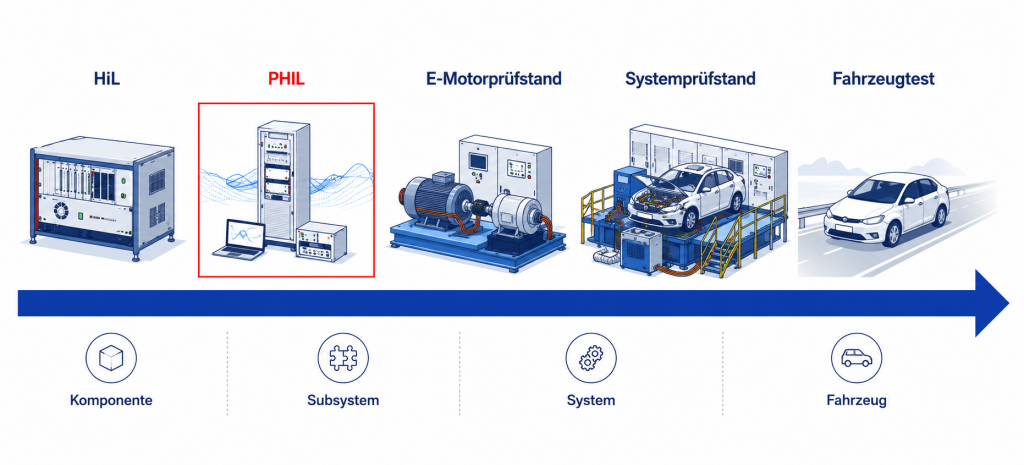
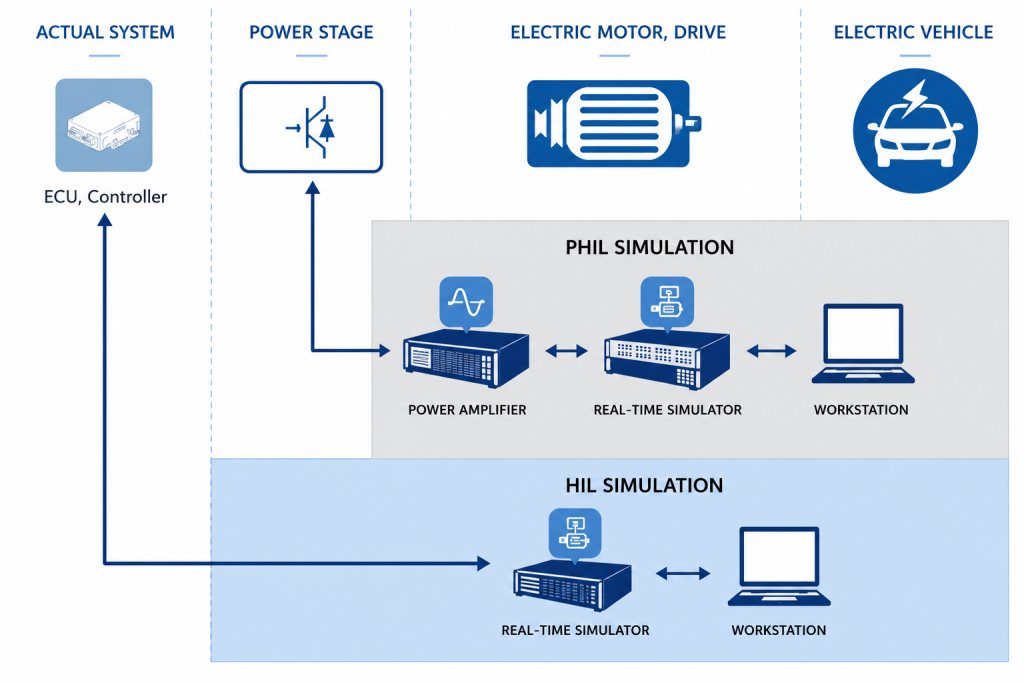
Power-HiL systems fill precisely this gap (see Figure 1). This technology extends traditional HiL systems by enabling the integration of real electrical power into the test setup. As a result, components can be tested not only at the signal level but also under realistic electrical conditions. The basic architecture initially resembles that of a traditional HiL system:
In addition, however, a power amplifier is used (see Figure 2). The real-time system transmits its calculated signals to the power amplifier, which uses them to generate actual voltages and currents for the DUT. The behavior of the component under test is then fed back into the real-time simulation. This creates a closed-loop control system between the virtual simulation and the actual power level.
Components such as electric motors or battery systems can still be modeled virtually. At the same time, however, the DUT operates with real electrical power parameters. This significantly expands the test depth compared to traditional HiL tests.
Typical applications of Power-HiL: Power-HiL systems are used in particular where real electrical loads and dynamic power conditions are relevant. Typical examples include:
Testing of on-board chargers: On-board chargers must be able to handle a variety of grid conditions. These include, for example, varying grid voltages or different charging infrastructures. With Power-HiL, such scenarios can be emulated in a reproducible manner.
Validation of inverter and drive components: Power electronics in the powertrain operate under high dynamics. Power-HiL makes it possible to simulate electrical load conditions early in the development process.
Development of battery systems: Battery systems and their control units also benefit from realistic load and charging profiles. At the same time, part of the vehicle environment remains virtual, allowing tests to be flexibly adapted.
Power-HiL systems offer several advantages over purely traditional testing approaches. One key benefit is the ability to account for real-world electrical effects early in the development process. This allows certain failure modes to be identified before full test benches or vehicle prototypes are available.
Added to this is the reusability of existing HiL infrastructures. Models, user interfaces, and automated test sequences from traditional HiL environments can often be reused. Especially when combined with modern test automation, this enables reproducible and scalable test processes. At the same time, a high degree of flexibility is maintained, as large parts of the vehicle can still be simulated virtually.
Power-HiL does not fundamentally replace traditional HiL systems. Rather, the technology extends existing test methods by enabling the integration of real electrical power flows into the simulation. This creates an additional test level between signal-based simulations and full test bench or vehicle tests.
This form of validation is becoming increasingly important, particularly in the context of electromobility and modern high-voltage systems. The combination of real-time simulation, power electronics, and test automation makes it possible to test complex systems under realistic conditions as early as the initial development phases.
ITPower Solutions has many years of experience in the fields of HiL, embedded systems, and test automation. We also support companies in the development and validation of complex electric vehicle systems through the integration of modern Power-HiL approaches.

I am your sales representative and will be happy to advise you on all questions relating to our services and products! Get in touch or simply make an appointment for a free consultation call.
Sebastian Stritz
E-Mail: sebastian.stritz@itpower.de
Telefon: +49 (0)30 6098501-17