Languages
 DE


An AI system can function correctly from a technical perspective and still cause problems when people interact with it. Particularly in the case of chatbots or AI assistants, functionality alone does not determine whether a system meets high quality standards. Equally important is how it behaves towards different users in specific situations.
This places greater emphasis on the user as part of the testing context. Beyond technical requirements, testing must consider who uses the system, the circumstances in which interactions take place and the potential consequences of AI outputs.
Conventional software systems are not tested in isolation from their context of use either. With interactive AI systems, however, this aspect becomes significantly more important.
A response can have different effects depending on a user’s age, prior knowledge, language proficiency, expectations or emotional state. What poses no problem for an experienced specialist may be confusing or misleading to a layperson.
For test design, this means that not only the system’s behaviour itself is relevant, but also the conditions under which it occurs. User groups, usage scenarios and critical interaction sequences should therefore be considered when defining requirements and designing tests.
These concerns are not limited to particularly vulnerable individuals. Any user can be adversely affected by AI systems. Risks include accepting statements uncritically, dealing with fake news, having one’s own thoughts reinforced without a reality check, and replacing social relationships, potentially extending to addictive patterns of behaviour.
For certain user groups, these risks may become even more significant. Examples include children and adolescents, older adults, people with limited digital literacy, and individuals in sensitive health-related or emotional situations.
The assistive system Elliq, for example, aims to alleviate loneliness in older adults by proactively interacting with users. In the morning, the AI robot provides a weather overview and asks users how they are feeling. Throughout the day, it suggests activities such as playing games, exchanging messages with family members or taking virtual tours of places of interest.
AI-enabled soft toys are already available for children. Through verbal interaction, they are intended to spark curiosity, convey knowledge through play, and support learning and the development of social skills.
These systems are designed to build an emotional connection with their users and respond in a personalised manner.
They can function flawlessly from a technical perspective and still generate responses that are inappropriate from an ethical or developmental psychology perspective.
The key question, therefore, is not simply whether a response is technically correct, but whether it is appropriate for the particular user and context of use.

This question cannot be answered from the perspective of software testing alone. Software testers can verify whether a system meets its requirements and behaves as expected in defined edge cases. The requirements for appropriate interaction, however, must be established beforehand.
Depending on the application, expertise from different disciplines may be required. User experience (UX) experts, for example, examine how users perceive and interpret information. Expertise in psychology or education may be relevant for systems that interact with children or people in emotionally challenging situations.
Domain experts are needed when the appropriateness of responses must be assessed from a specialist perspective, for example in medicine, industry or mobility. Safety and security specialists examine potential risk scenarios, consequences of harm and protective measures. Accessibility, legal and regulatory requirements must also be considered.
Interdisciplinary AI testing does not mean involving as many disciplines as possible in every project. Rather, the key is to determine which perspectives are required for a particular application in order to establish sound requirements and boundaries for user interaction.
Broader test scenarios are therefore well suited to interactive AI systems. Rather than examining individual inputs and outputs in isolation, it makes sense to consider specific usage situations and complete interaction sequences.
A test scenario might, for example, describe how a user responds to misinformation or how a conversation develops as a user shares increasingly personal or sensitive information. For AI systems that provide advice, testing can examine whether the system communicates uncertainty about its outputs or further reinforces a user’s incorrect assumptions.
Particularly in conversational systems, problematic dynamics may only emerge after several interaction steps. Testing should therefore not necessarily end after a single response.
Relevant questions include: Does the system correct its own errors? Does it reinforce problematic assumptions? Does it recognise critical situations? Does it respect defined boundaries? Does its communication remain understandable and appropriate throughout the interaction? This extends the conventional test case into a usage scenario in which the system, the user and the context are considered together.
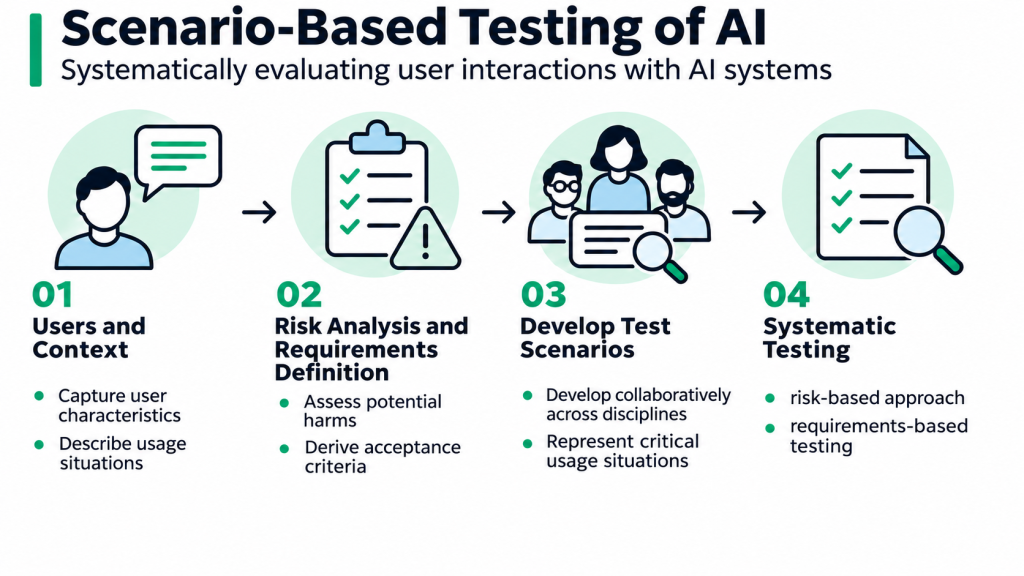
Taking greater account of the context of use begins before testing itself. The relevant requirements must first be defined. Which interactions are permissible, undesirable or critical should be determined through requirements and risk analysis, domain expertise and, where applicable, regulatory requirements.
Testing then translates these requirements into specific scenarios and verifies whether the system meets them. Alongside functional requirements, relevant criteria may include transparency, human oversight (human-in-the-loop), robustness, traceability or the handling of particular user groups.
Regulatory requirements are also important in this context, particularly those of the AI Act. Certain AI systems are subject to regulatory requirements covering areas such as risk management, documentation, transparency, human oversight, robustness and cybersecurity. The specific requirements that apply depend on the intended application and the regulatory classification of the system.
Testing does not establish compliance on its own, but it can make an important contribution to demonstrating it. Requirements, test cases and results should therefore be linked in a traceable manner. This provides verifiable evidence that defined requirements have been implemented and relevant risks have been systematically considered.
Technical performance remains a quality criterion for evaluating AI systems. For applications that interact directly with people, however, it is not always sufficient.
User groups, usage situations and the potential consequences of interactions must be considered when defining requirements. This brings additional perspectives into testing, ranging from user experience and psychology to domain expertise, safety, security and compliance.
The role of testing is not to determine what behaviour is acceptable. That is a responsibility shared by society as a whole. Rather, the role of testing is to translate requirements defined through interdisciplinary collaboration into representative test scenarios and systematically verify them. This is one of the central challenges of testing interactive AI systems.

I am your sales representative and will be happy to advise you on all questions relating to our services and products! Get in touch or simply make an appointment for a free consultation call.
Sebastian Stritz
E-Mail: sebastian.stritz@itpower.de
Phone: +49 (0)30 6098501-17